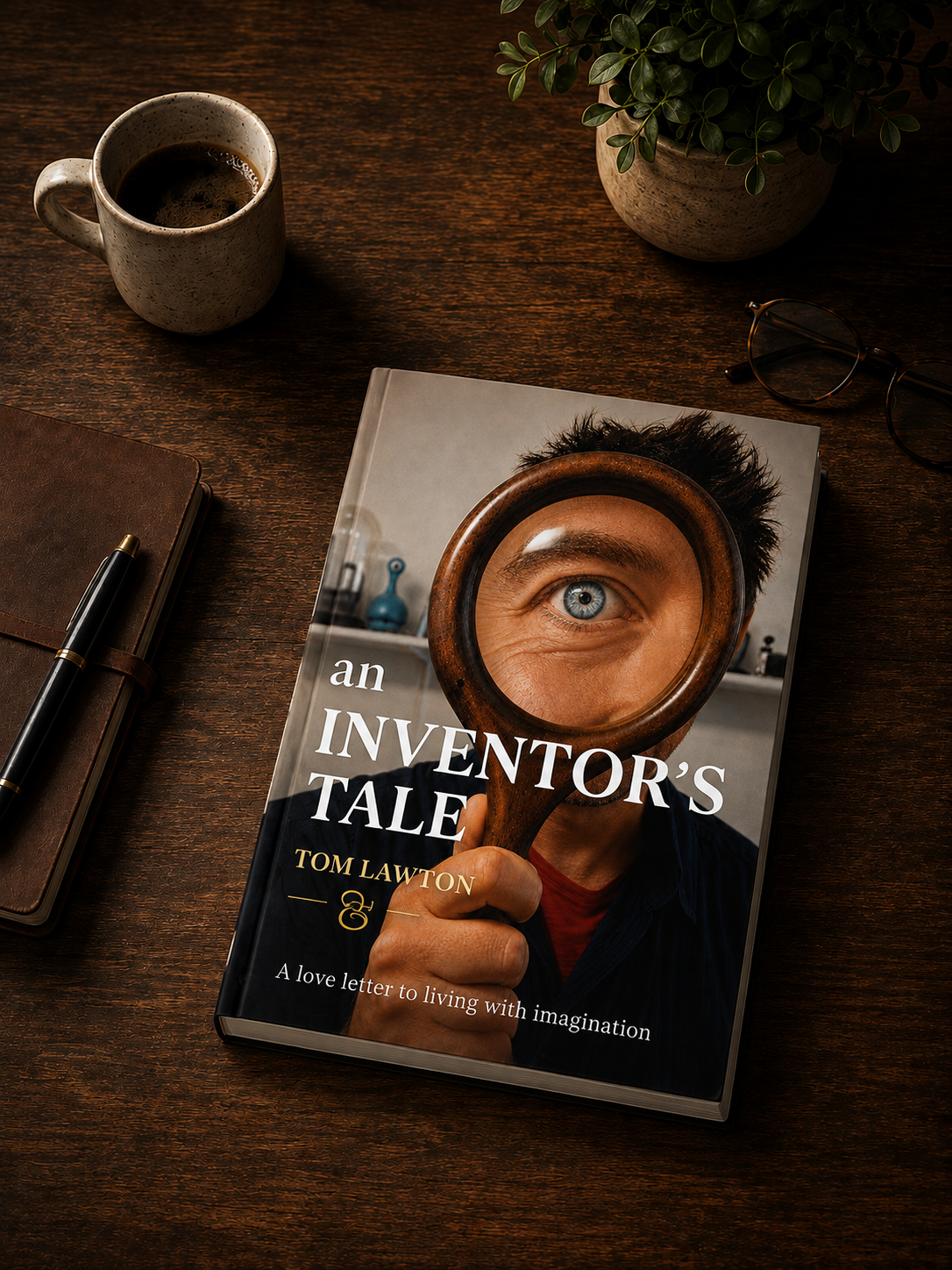
1.An Introduction
Introduces Wonder Horse, the hopeful inner creature that keeps pulling me towards curiosity, invention, beauty, connection and occasionally glorious disaster. Establishes the book not as a record of achievement, but as a story about attention, possibility and remaining awake to the wonder hidden in ordinary life.
2.The Crab and the Rockpool
Explores my understanding of creativity as something that cannot be forced: an intuitive process requiring patience, stillness and trust. The crab in the rockpool becomes a metaphor for ideas themselves — something more likely to emerge when we stop disturbing the water.
3.A Boy Named Horse
Begins the family story with my great-grandfather John William Barnes, who survived the First World War partly through the extraordinary technique of riding beneath his horse while carrying ammunition through the trenches. It establishes the origins of Horse, the nickname by which I am affectionately known, my instinct for unconventional solutions, and the importance I place on freedom, non-judgement and responding to adversity with dignity.
4.The Wolf and the Tiger
Revisits my earliest memory: an intense childhood encounter with a captive wolf that became an imaginative pact to live as freely as possible. Childhood fears, tigers, drawings and later family coincidences introduce the recurring interplay between imagination, symbolism and real life.
5.Tom
A short, playful reflection on identity and ordinariness. For all the unusual experiences to come, I establish that I am ultimately just another Tom — one of many — and therefore not fundamentally different from the reader.
6.Jerry
A tiny meditation on childhood imagination and magic, centred on an early imaginary — or perhaps not entirely imaginary — friend called Jerry.
7.The Architect and the Flayme
A poetic interlude drawing together Daedalus, Heraclitus, labyrinths, transformation and flow. It introduces an idea that will become central to the book: that movement changes the person moving, and that meaning often reveals itself through the act of continuing.
8.I Am Wonder
A deliberately contradictory inventory of the identities I have accumulated — father, inventor, artist, prisoner, Fellow of the RSA, underdog, mentor, misfit, storyteller and many more. It ultimately rejects labels altogether: I am wonder, and so is everyone else.
9.Family of Horses
Introduces the sprawling family that shaped me: grandparents, parents, siblings, extended family, Charlie and my sons. Through eccentricity, achievement, love, disagreement and inherited character, family emerges as perhaps the most demanding — and important — spiritual path of all.
10.The Walnut Tree
Recalls the childhood walnut tree I climbed to find silence, perspective and a feeling of connection with the natural world. It establishes an early version of something I would spend much of adult life trying to rediscover: becoming quiet enough to listen.
11.Supersleigh
My first memorable engineering adventure: building a sledge from Blue Peter plans, discovering that it didn’t work, modifying it, and eventually using it to escape from a spectacularly deep heap of cow manure. A comic childhood story that introduces experimentation, iteration and a recurring lesson: sometimes your own creations really do save you when you’re in the shit.
12.The Extractor Fan
Explores my lifelong attraction to white noise, stillness and the altered imaginative state I first discovered lying beneath an extractor fan as a child. What once seemed an eccentric private habit later connects with meditation, ASMR and my continuing need to create quiet internal space amid a noisy world.
13.Fisher Price
Childhood toys, making, fixing and watching my engineer father repair things become an informal education in mechanisms and invention. A painfully comic encounter with a Fisher-Price rack-and-pinion mechanism ensures that my first serious lesson in how machines work is one I am unlikely ever to forget.
14.Somerset
Returns to the landscape and soil of South Petherton, where childhood freedom, village life and watching my mother work manure into the earth planted memories that would resurface decades later in the conception of Bioturbonics. The future invention is quietly present in the soil long before I know it exists.
15.School Days
Moving from Somerset to Wiltshire means leaving childhood friends and starting again at a new comprehensive, where being bright, artistic and different proves both an advantage and a liability. Through bullying, friendship, humour, loss and adolescent embarrassment, I learn to embrace being unusual and begin finding confidence on my own terms.
16.The Combe Boys
Introduces the close-knit gang of friends who became my youthful tribe and partners in the largely undocumented freedoms and mischief of the early 1990s. Written after prison, the chapter deliberately leaves much of that mythology between us, contrasting the freedom of youth with the consequences and caution of adult life.
17.Maharabat
Celebrates the gloriously invented garden sport that my brother and friends turned into a ritual of competition, friendship and physical release. It captures the balance of working hard and playing harder that helped carry me through GCSEs and A-levels.
18.Peace Be With You
Explores my lifelong aversion to violence through bullying, confrontation and one frightening attack on my brother that finally provoked me to fight. The lasting lesson is not machismo but the opposite: violence is ugly, complicated and best avoided whenever possible.
19.Bournemouth
Product Design at Bournemouth University gives a name and discipline to the thing I had always instinctively done: make things. Art, engineering, psychology and imagination converge, leading eventually to WakeYoo — my first serious invention — and the beginnings of both my professional life and my relationship with Charlie.
20.Cape Town
A speculative industrial placement becomes a formative year in post-apartheid South Africa: Johannesburg, Cape Town, pioneering 3D visualisation, extraordinary friendships, danger, travel and complete creative freedom. Experiences with real-time virtual environments and panoramic landscapes sow ideas that will eventually become BubbleScope.
21.The Ironing Board
Faced with choosing a final-year invention, I investigate everything from wind-up torches to alarm clocks — and briefly the reinvention of the ironing board, including an eccentric rooftop experiment captured on Polaroid. When Extreme Ironing subsequently becomes an international phenomenon, it reinforces my fascination with the strange ways similar ideas can emerge independently.
22.WakeYoo
My frustration with the conventional alarm clock becomes a recordable device that lets people wake to their own voices and intentions. From university project to patent, licensing deal, Hamleys, Harrods, Argos, QVC and 250,000 sales, WakeYoo gives me my first taste of commercial invention — and my first painful lessons about what happens when creativity meets business.
23.Garden Hose Pipe Replacement
A completely fictitious emergency hose-pipe business, emblazoned across Charlie’s car, becomes an affectionate example of my lifelong enjoyment of absurdity, improvisation and making ideas physically real simply because they amuse me. It is invention without commercial ambition: creativity as play.
24.The Same Again
A casual pub phrase becomes an attempted beer trademark and an early lesson in intellectual-property law when the application is rejected because customers might unwittingly order it. Years later, the idea nevertheless reaches the real world as a beer for Jimmy’s Farm — a reminder that ideas don’t always become what you first imagined, but can survive in other forms.
25.The Vicarage
A chance meeting with photographer Sid leads to a wonderfully eclectic shared house outside Bath and a period of friendship, experimentation and creative independence. The Vicarage becomes less a building than a formative community around the young inventor I am becoming.
26.Lost
An adventurous chapter of friendship, travel and unexpected human connection that tests trust and the willingness to say yes to life. Its lasting theme is brotherhood with strangers and the strange generosity that can appear when plans fall apart.
27.Television
Despite barely watching television myself, I discover that I am surprisingly comfortable making it: selling thousands of WakeYoos live on QVC and later helping children develop inventions on CBBC’s My Genius Idea. Television proves fun and occasionally powerful, but never quite becomes the world in which I want to live.
28.BubbleScope
A desire to capture experience beyond the rectangular photographic frame becomes an obsession with immersive 360-degree imagery. From an Indian train and early virtual-reality work in Cape Town to patents, optical engineering and a failed manufacturing deal, BubbleScope arrives years before the technology and market are truly ready — but the idea escapes into the world.
29.Crash
A catastrophic head-on collision in rural France at twenty-six destroys my right knee and begins years of surgery, infection, rehabilitation and pain. The long struggle back to movement reshapes my understanding of resilience, disability, love, gratitude and the simple necessity of continuing when giving up would be easier.
30.Malmesbury
The ancient Wiltshire town becomes home, community and creative sanctuary for more than twenty years — and later the place from which my life dramatically unravels. Its eccentrics, abbey, river, friendships and stories teach me that belonging is less about ownership than the small traces of creativity and kindness we leave behind.
31.The Gay Horse Olympics
My best men construct an extraordinary stag weekend as a mystery journey involving planes, strangers, ferries, horses and finally a gathering of friends in Pembrokeshire. Beneath the glorious absurdity lies an exceptionally tender pilgrimage to the grave of Charlie’s father, where I finally ask for his daughter’s hand in marriage.
32.Charlie
The story of meeting, loving and marrying Charlie, becoming part of her family, and creating our own with Barney and Rufus. It also faces honestly the eventual end of our marriage and my recognition that the obsessive uncertainty of life with an inventor carried a cost for the person who shared it with me.
33.Addiction
Uses my own relationships with smartphones, social media, nicotine, weed, television and even the sanctuary of a car to explore attachment in modern life. Rather than preaching abstinence, I arrive at a simpler concern: whether we retain power over our comforts or quietly surrender our freedom to them.
34.Kindness
Two encounters with elderly women on London transport unexpectedly connect me first to Derren Brown and later to the editor of Robb Report. Neither began as networking; both began by noticing another human being, reinforcing my belief that kindness is valuable precisely because it isn’t a transaction.
35.Firewinder
A desire to turn bad weather into beauty becomes a wind-powered illuminated sculpture, developed through engineering, experimentation and stubborn optimism. Firewinder wins major sustainability awards and lights Glastonbury Tor before manufacturing failure destroys the business — leaving behind a hard lesson that something can fail commercially and still have been worth creating.
36.Elegant Bodger
Reflects on the inventive spirit inherited from my engineer father and encountered in practical problem-solvers everywhere — from elegant engineering to gloriously improvised bodges. A catalogue of successful, failed and ridiculous inventions leads to a central belief: invention is fundamentally hopeful because it begins with believing reality can be changed.
37.The Skateboard Bike
A practical school-run problem becomes perhaps the most joyful invention I ever make: a skateboard cable-tied to the front of a folding bicycle for Barney, and later Rufus, to ride. Never commercialised, it becomes seven years of shared adventure and a reminder that some inventions are valuable precisely because they remain personal.
38.My Boys
The births of Barney and Rufus transform my understanding of love almost instantaneously. A short, intimate chapter about the privilege of fatherhood and the two completely individual souls who become the emotional centre of my life.
39.BubblePix
The earlier BubbleScope vision returns when smartphones finally provide the computing power I had been waiting for. A bootstrapped team builds hardware, software and a social platform for immersive imagery, wins awards and attracts Apple, BlackBerry and Samsung before better-funded technology eventually catches up — teaching me that sometimes an inventor’s role is simply to arrive early enough to help prove the future possible.
40.Tom's Fantastic Floating Home
An unexpected Channel 4 opportunity becomes three hours of primetime television in which an old pilot boat is transformed into a floating imaginarium of absurd inventions. The experience is exhilarating and successful, but also exposes the artificial machinery of television and confirms that I am happiest when the camera follows genuine making rather than when making exists for the camera.
41.The Sausage Jockey
A campfire problem — sausages burning unless constantly turned — becomes an absurdly serious exercise in heat-powered rotisserie engineering. The prototype ultimately proves over-engineered for a problem that barely exists, but perfectly illustrates the pleasure of following an idea simply to discover whether it can work.
42.Million Mile Light
A dark evening run inspires a tiny battery-free safety light powered entirely by the movement of its wearer. Nearly a hundred prototypes, successful crowdfunding, awards and tens of thousands of exceptionally reliable units turn it into one of my strongest commercial inventions, while its purpose remains deeply human: helping vulnerable people to be seen.
43.Uplift
Against the noise and division of Brexit and my grandmother’s dementia, I ask myself what the most beautiful thing I could bring into the world might be. The answer becomes Uplift, a solar-powered kinetic sculpture that unexpectedly transforms me from product designer towards artist — and teaches me that beauty, stillness and wonder can themselves be useful.
44.Greenhouse
A workshop with my longtime inspiration Stephen Russell, the Barefoot Doctor, leads to a startling experience in which I apparently identify the word another participant is holding in his mind: ’Greenhouse.’ Rather than offering it as proof of anything supernatural, I take it as permission to trust more deeply the quiet intuitive voice that has guided much of my creative life.
45.Wonder
After years of solving practical problems, I begin following a different kind of creative question: whether geometry, movement and beauty can simply make people feel something. Spirals, natural patterns, Qigong, conversations about living systems and the death of Stephen Russell gradually converge into a form that feels less invented than discovered.
46.Bringing Wonder to Life
During lockdown, the mysterious geometry becomes a precise physical sculpture whose slow, silent movement produces unexpected optical harmonies. Installed first quietly in Malmesbury and then in the Abbey, Wonder reaches millions online and provokes reports of calm, awe, goosebumps and tears — changing my relationship with creativity from ownership towards stewardship.
47.Gentle Force
The geometry behind Wonder leads in an entirely different direction: a patented bi-helical architecture inspired by earthworm bioturbation and the childhood memory of my mother weaving manure into Somerset soil. With soil scientists, I begin asking whether a machine could work more like nature than a bulldozer — gently helping regenerate damaged soils and perhaps one day preparing lifeless ground elsewhere.
48.Pandemic Pantomime
My personal account of lockdown focuses less on arguments about who was right than on what collective fear, uncertainty and isolation revealed about human behaviour. Against patent defeat, family pressure and psychological overload, creativity and the still-secret Wonder become ways of protecting my mind and maintaining agency.
49.Nobody's Hero
A series of emergencies — from rescuing people from an overturned car to helping strangers in danger — reveals a recurring instinct to move towards a problem rather than away from it. I reject the idea of heroism, but establish the pattern that becomes crucial when a woman collapses at my sons’ school.
50.Forty-Two Minutes
On an ordinary school pickup, I find another parent in cardiac arrest and perform CPR for forty-two minutes with the help of others until emergency services arrive. The experience saves a life but also becomes a devastating personal threshold: in helping save somebody else’s wife, I realise how profoundly my own marriage has already broken down.
51.Holding the Portal
The physical and psychological aftermath of the woman’s collapse collides with the rapid disintegration of my marriage, home and sense of self. As she lies in a coma, Wonder gives me a thread beyond my own crisis, leading to conversations about taking it to Bethlehem — and then the extraordinary news that she has awakened.
52.Bethlehem
With no claim to expertise in Middle Eastern politics, I follow an unexpected impulse to offer Wonder to Bethlehem as a symbol of peace amid renewed conflict. The chapter is less about geopolitics than the human instinct to answer suffering with something beautiful, however small or improbable.
53.Beyond Wonder
Wonder expands from sculpture into a wider inquiry about flow, pattern, Heraclitus, the Tao and the hidden order I perceive beneath apparent chaos. Encounters with scientists, philosophers, mystics and strangers deepen my sense that I am less Wonder’s owner than its custodian, while its geometry simultaneously points towards the soil-regeneration work to come.
54.The Light Returns
The accumulated pressures of trauma, marriage, business, money and exhaustion finally become a nervous breakdown, followed by separation, insolvency, homelessness and a profound loss of identity. Recovery comes not through one revelation but slowly through family, friends, movement, ordinary work, kindness and human connection — until I begin noticing beauty again.
55.Winchester
One terrifying and profoundly uncharacteristic day in August 2025 ends with police, hospital, custody and HMP Winchester. I describe the events from inside my own frightened perception without pretending to possess explanations I don’t have, beginning the book’s deepest examination of fear, uncertainty and how quickly a life can change.
56.The Captain and the Galleon
A fable written for my boys turns my life into the story of a captain, a treasured ship and an impossibly heavy golden anchor. When the captain finally lets go of what is dragging him under, the love of his sons — and the trees of home — guide the drifting vessel back towards safety.
57.The Monastery
Prison strips away phone, internet, privacy, possessions, nature and almost every familiar marker of identity. Amid noise, violence and suffering I unexpectedly rediscover discipline, art, meditation, compassion and interior stillness, gradually seeing Winchester less only as confinement and more as a brutal monastery in which I am forced to meet myself.
58.Alfie
Life inside was much harder than it might appear from the stories I tell about it. The experience was breaking us both, but perhaps making us too. Alfie was twenty-two. I was forty-nine. No difference. We had perhaps twenty minutes together each day — pockets of kindness and human connection that felt like coming up for air. We drew, talked and once found ourselves moving an idea for bioturbonics forwards with a pencil and some paper. Only later did I learn what the letter M beside his name meant. By then I had met Alfie, not the label. In the nothingness of prison, those twenty minutes mattered.
59.Expression Conkers Depression
Drawing and writing become the practical means by which I remain psychologically alive in prison. From toothpaste affirmations and Biro drawings to Koestler Award entries, art mentoring and becoming caretaker of the multi-faith chapel, expression changes from something I do into something I understand as essential to human wellbeing.
60.Jesus Christ Pose
The surreal experience of standing trial forces me to confront body-camera footage, accusations and the public spectacle of the worst day of my life. Amid humiliation and absurdity, I rely on the one strategy available to me — telling the truth as I experienced it — and emerge with a complicated understanding of fear, consequence and surrender.
61.Liberated from Expectation
A short lyrical meditation on living without attachment to judgement, certainty or outcome. It gathers many of the book’s recurring ideas — intuition, transformation, truth, love, grounded ambition and acceptance — into an attempt to describe what freedom now means to me.
62.Biros
Returns to the unanswered questions surrounding my arrest, imprisonment and trial, while refusing to let those uncertainties become the whole story. The accumulating empty Biros become a measure of something more important: the act of writing myself through confinement and recovering agency through truthful expression.
63.Back to Earth
Freedom arrives not as a triumphant cinematic ending but as birdsong, touching a tree, family embraces, Universal Credit, stroopwafels, exercise and the practical business of beginning again. Back in the world, I carry the handwritten manuscript with me and start rebuilding a life with fewer possessions but considerably greater trust in myself.
64.Act in Love
A brief multi-faith reflection on truth, righteousness, faith, discernment and the idea that the strongest response to darkness is not retaliation but love. Its instruction is deliberately simple: be discerning and act in love.
65.The Way of Wonder
The philosophical destination of the book: Wonder is not an object or an achievement but a way of seeing and responding to life, especially when life is difficult. I offer no prescription, only permission — to express, begin again, trust yourself, remain curious and remember that imagination guided by compassion can still make the world better.
66.Goosey Gander
A tiny absurdist conversation between an Englishman and a supposedly Canadian goose gently dismantles ideas of nationality, belonging and imposed identity. The goose knows only that wherever it is, it is here — and at home in itself.
67.Tabula Rasa
After losing business, marriage, home, plans, certainty and eventually liberty, I discover that the blank slate is never truly blank — and that freedom is ultimately internal. Inventor, entrepreneur and artist resolve into a simpler identity: caretaker of ideas, beauty, people and possibilities, with enough unwritten space still ahead to begin again.
68.Jerusalem
Released and moving through England again, I cycle towards London, reconnect with family and my boys, pitch the book, encounter strangers and begin seeing my country with renewed affection. A Father’s Day in Greenwich with Rufus and a call from Barney in Brazil turns Jerusalem from a physical place into a way of seeing: a belief that beauty, kindness, imagination and love still matter.
69.London
Living cheaply in a Camden hostel while working from RSA House, I find myself energised, focused and once again full of ideas. The book ends not with everything resolved but with the next experiments already visible — Wonder at Greenwich and Bioturbonics in depleted soil — before reality intervenes beautifully with a bicycle locked at Paddington and a missing key.
70.No Entry
A door closes, but life keeps moving. Back in London, I find myself navigating rejection, unexpected kindness, new friendships and fresh possibilities for Wonder and Bioturbonics. From the RSA to Malmesbury Abbey, Greenwich and the strange stillness at the centre of a vortex, No Entry becomes a meditation on belonging, time, love, invention and what happens when life refuses to follow the route you imagined. It ends with perhaps the simplest question in the book: does an ordinary life deserve to be told? Yes. And perhaps yours does too.
71.Ground Zero
Back at zero, I discover that starting again might not mean having nothing — it might mean having somewhere to begin. On my way to Greenwich with two proposals for Wonder, a conversation with an old engineering friend opens another door for Gentle Force: from living soils to stagnant lakes, roots, mycelium and the possibility that geometry itself might do some of the thinking. The journey ends beside the Cutty Sark, with changing seasons, the loss of a friend and Giant Wonder resting, quite literally, in Hope Mills. Sometimes moving forward begins by standing still long enough to notice that you are alive.
72.I Don’t Know. Do You Know?
I return to the most frightening and unresolved morning of my life — not to prove what happened, but finally to put it down. What follows becomes a meditation on memory, fear, healing and the difficult territory between trusting yourself and leaving room to be wrong. A chance encounter with a Jedi on a traffic island leads to a larger question beneath the whole tale: when the jobs, successes, failures, money, reputation and labels fall away, who are we when nobody is looking? Perhaps we don't need to know. Perhaps learning to live honestly with the question is enough.
73.Authentic Action
By now I had stopped waiting for everything to make sense before taking the next step. I had my boys. I had a book. I had Wonder. I had ideas I believed in and people I loved. Authentic action, I realised, wasn't about knowing where everything would lead. It was about doing the next thing that felt true, with what I had, from where I was.
A path appears as you walk it.
Epilogue
Just when the story appears finished, life supplies another beginning. Professor Mazin Qumsiyeh writes from Bethlehem to say that his new Natural History Museum is complete and asks whether Wonder might come there. An idea first imagined during one of the darkest periods of my life suddenly becomes a real invitation — and the book closes not with an ending, but with the determination to find a way.